

Transcatheter arterial embolization with n-butyl cyanoacrylate versus gelatin sponge particles for gastric cancer-related upper gastrointestinal bleeding: a comparison of efficacy and safety
Deyu He
 , Liming Shao, Yixing Xie, Xiaolong Zhao, Zhaolong Zhang, Rui Xu, Chengjian Sun, Guoping Liu
Contributions: (I) Conception and design: ; (II) Administrative support: ; (III) Provision of study materials or patients: ; (IV) Collection and assembly of data:; (V) Data analysis and interpretation: ; (VI) Manuscript writing: All authors; (VII) Final approval of manuscript: All authors.
Background: This single-center retrospective study aimed to compare the efficacy and safety of N-butyl cyanoacrylate (NBCA) versus gelatin sponge particles (GSPs) as embolic agents in transcatheter arterial embolization (TAE) for gastric cancer-related upper gastrointestinal bleeding (GC-UGIB).
Methods: From January 2018 to December 2024, 85 patients undergoing TAE for GC-UGIB were analyzed. Patients were stratified by embolic agent: NBCA (n=36) and GSP (n=49). Primary outcomes included technical and clinical success, 30-day rebleeding rate, complications, and 30-day mortality. Multivariable logistic regression identified predictors of clinical success.
Results: Technical success was 100% in both cohorts. The NBCA group was associated with a significantly higher rate of clinical success compared to the GSP group (86.1% vs. 67.3%, P=0.047). Rebleeding rates were significantly lower in the NBCA group at both 30 days (19.4% vs. 40.8%, P=0.03) and 6 months (30.6% vs. 57.1%, P=0.01). No major complications occurred; minor complication rates were comparable (36.1% vs. 32.7%, P=0.74). Multivariable analysis identified the use of NBCA (vs. GSP) as an independent factor associated with clinical success [adjusted odds ratio (aOR) =4.461; P=0.047]. Preoperative hemoglobin ≤60 g/L, coagulopathy, and clinical failure were associated with 30-day mortality.
Conclusions: In this retrospective study of TAE in GC-UGIB, NBCA is a safe and effective embolic agent, achieving superior clinical success and significantly lower medium- to long-term rebleeding rates compared to GSP. These findings suggest that NBCA may be a favorable embolic option, though prospective validation is needed.
Keywords: Gastric cancer; upper gastrointestinal; bleeding; transcatheter embolization; interventional radiology
Submitted Dec 28, 2025. Accepted for publication Feb 27, 2026. Published online Mar 25, 2026.
doi: 10.21037/jgo-2025-1-1083
Highlight box
Key findings
• Report here about key findings of the study.
What is known and what is new?
• Report here about what is known.
• Report here about what does this manuscript adds.
What is the implication, and what should change now?
• Report here about implications and actions needed.
Introduction
Gastric cancer (GC), a common malignant tumor of the gastrointestinal tract, was responsible for about 968,000 new cases (4.9% of all cancers) and 660,000 deaths (6.8% of cancer-related mortality) worldwide in 2020, ranking fifth in both incidence and mortality globally (1-3). Acute upper gastrointestinal bleeding (UGIB) is a common and serious gastric cancer problem with the incidence rate of 5–10%. This complication primarily occurs in the advanced stages of the disease, with tumor-node-metastasis (TNM) stages III and IV representing over 80% of cases, and is frequently associated with hemodynamic instability and coagulopathy (4-6). It can cause hemodynamic disturbances such as rapid hemoglobin drop (>20 g/L), low systolic blood pressure (>80 mmHg) and transfusion dependent refractory anemia that may delay anticancer treatment (surgical or chemotherapy). In severe cases it can be life-threatening (6-8).
Endoscopic treatment of gastric cancer-related upper gastrointestinal bleeding (GC-UGIB) can often fail (between 33% and 80%) (5,9,10). Transcatheter arterial embolization (TAE) has been identified as the most popular interventional treatment of GC-UGIB: superselective occlusion of tumor-feeding arterials can achieve high technical success rates of 94.9% to 100%, and good safety profile (major complications occur at a rate of 0.9% to 3.5%). TAE is particularly useful for advanced gastric cancer patients, those who fail endoscopic treatment, and for high risk surgically involved patients (4,9,11-13).
Various embolic agents are available for TAE in GC-UGIB, including gelatin sponge particles (GSPs), metallic coils, polyvinyl alcohol (PVA), and N-butyl cyanoacrylate (NBCA) (14). At present, GSP is usually selected as the embolic agent for upper gastrointestinal bleeding caused by gastric cancer (GC-UGIB) in clinical practice. NBCA, as a liquid permanent embolic agent, can achieve permanent occlusion and is not affected by the coagulation state. Therefore, it is increasingly used in gastrointestinal bleeding. However, due to the risk of catheter entrapment and non-target embolization, it requires a high level of technical proficiency when used. For TAE in GC-UGIB, the best embolic agent remains uncertain. Although some studies have suggested that NBCA may have potential benefits in non-variceal upper gastrointestinal bleeding (NVUGIB) (15-17), the evidence regarding its safety and efficacy in GC-UGIB is very limited.
Therefore, we conducted this retrospective study to compare the safety and efficacy of NBCA versus the conventional agent GSP in TAE for GC-UGIB, with the aim of providing preliminary evidence to inform clinical decision-making and generate hypotheses for future prospective trials. We present this article in accordance with the STROBE reporting checklist (available at https://jgo.amegroups.com/article/view/10.21037/jgo-2025-1-1083/rc).
Methods
Study design
This single center retrospective cohort study was approved by the Ethics Committee of the Affiliated Hospital of Qingdao University (No. QYFYWZLL30236) and consisted of 85 consecutive patients who underwent TAE for GC-UGIB at our institution’s Interventional Medicine Center between January 2018 and December 2024. Patients were divided into two groups according to the embolic agent used in TAE: NBCA group (n=36) and GSP group (n=49). The study began with the implementation of the interventional surgery, and the follow-up ended at 6 months after the surgery or when the patient passed away. Written informed consent was obtained from all participants or their legal authorized representatives before the procedure. We collected detailed information such as demographic characteristics, clinical parameters, tumor pathology and stage, technical success rate, clinical outcomes, 30-day mortality rate, complications and long-term survival rate based on electronic medical records and imaging examinations to compare the efficacy and safety of NBCA and GSP as embolic agents in TAE for GC-UGIB. The sample size of this study was determined based on the clinical visit volume of GC-UGIB patients in our hospital from 2018 to 2024. Combined with the effect size estimation from previous similar studies (Gong et al., 2023; Park et al., 2017), an 85-case sample size is sufficient to meet the comparison requirements for the two groups’ primary outcomes (30-day rebleeding rate).
Inclusion and exclusion criteria
The research subjects were 85 consecutive patients who underwent TAE for GC-UGIB at the Interventional Medicine Center of Qingdao University Affiliated Hospital from January 2018 to December 2024. According to the embolic agents used in the TAE procedure, the patients were divided into two groups: the NBCA group (n=36) and the GSP group (n=49).The inclusion criteria were (I) age 18 years; (II) histopathologically confirmed gastric cancer; (III) active bleeding [computed tomography (CT)/digital subtraction angiography (DSA)], indicated by contrast agent leakage on enhanced CT/CT angiography (CTA), or clinical signs such as hematemesis, persistent melena, and/or a 24-hour hemoglobin decrease of 20 g/L; (IV) primary treatment with TAE. The inclusion criteria were (I) bleeding not related to gastric malignancy; (II) lack of follow-up; (III) significant preprocedural organ dysfunction (cardiac, hepatic or renal impairment); (IV) during the TAE procedure, multiple embolic agents are used in combination for embolization (such as NBCA combined with GSP); (V) follow-up less than 6 months postprocedure. The follow-up was conducted by requiring patients to undergo regular outpatient check-ups after the surgery and by conducting monthly phone follow-ups.
TAE procedure
All endovascular interventional procedures are independently performed or fully supervised by physicians who have completed specialized training in interventional radiology. All operators have at least 10 years of clinical experience in vascular interventional procedures and have been exclusively engaged in TAE related work in our hospital for more than 5 years. Throughout the study period [2018–2024], the technique and equipment for TAE remained consistent, with no major changes in catheter technology, embolic agents, or embolization protocols. All procedures were performed or supervised by the same core group of experienced interventional radiologists, minimizing potential learning-curve effects. A standardized embolization protocol was rigorously adhered to. The choice of embolic agent (NBCA or GSP) was made by the attending interventional radiologist based on clinical judgment, considering factors such as the patient’s coagulation status, the caliber and tortuosity of target vessels, the hemodynamic stability of the patient, and the operator’s experience with each agent. During the study period, no strict institutional protocol mandated one agent over the other, reflecting real-world clinical practice. Preprocedural emergency angiography was routinely performed. Selective catheterization of the celiac axis, superior mesenteric artery, and splenic artery was accomplished using 5-French Tempo angiographic catheters (Cordis, Johnson & Johnson, City, Country). If the bleeding source was not immediately apparent, superselective angiography with 2.6-French coaxial microcatheters was employed to assess potential tumor-feeding vessels, such as the left gastric, right gastric, gastroduodenal, gastroepiploic, and posterior gastric arteries, aiming to minimize false-negative findings.
Angiographic findings were classified into three types: Type 1 (contrast extravasation), Type 2 (arterial pseudoaneurysm), and Type 3 (tumor blush or absence of detectable abnormalities). Types 1 and 2 were considered positive indicators of active hemorrhage, while Type 3 was considered a negative angiographic finding. Embolization was carried out using either NBCA (Compont) or GSP (Alicon) until complete or near-complete cessation of antegrade flow was achieved. The selection of gelatin sponge particle sizes and NBCA-Lipiodol mixture ratios (typically ranging from 1:1 to 1:7) was tailored based on real-time assessments of target vessel anatomy and hemodynamic conditions. Technical success was confirmed through completion angiography. In cases with negative angiographic findings, empirical embolization of tumor-feeding vessels identified on preprocedural contrast-enhanced CT or CTA was performed (see Figure 1 for an example).

Outcome assessment
Therapeutic efficacy was assessed using a multidimensional framework that included: (I) treatment success rates; (II) rebleeding events; (III) survival outcomes; and (IV) complication profiles. Evaluations were conducted at clinically relevant time points: 7 days (short-term), 30 days (intermediate-term), and 6 months (long-term). The specific objectives were: (I) at 7 days, monitoring acute symptomatic improvement, such as the frequency of hematemesis and hemoglobin trends; (II) at 30 days, determining clinical success; and (III) at 6 months, evaluating the durability of the treatment.
Treatment success rate
Success was measured both by technical and clinical criteria. Technical success was either complete closure of target vessel (includes trunk and all branches) or reduction of blood flow by at least 90% (included by absence of contrast extravasation on DSA post-embolization). Clinical success was defined as a combination of the following endpoints: (I) hemostatic efficacy was defined as absence of major rebleeding within 30 days allowing minor bleeding to be managed conservatively within 72 hours. (II) Disease control: no requirement for second intervention (endoscopic, surgical or repeat embolization) within 30 days. (III) Hemodynamic stability was defined as requirement of no more than 2 units of red blood cells transfused in the 24 hours post-TAE, and a hemoglobin drop <15 g/L within 24 hours. (IV) Survival was defined as absence of hemorrhage based death within 30 days except non-hemorrhage deaths (Figure 2).

Rebleeding events
Rebleeding was characterized by the recurrence of hematemesis or melena, a hemoglobin drop of ≥15 g/L within 24 hours, or radiological evidence of active contrast extravasation.
Survival outcomes
Survival outcomes were analyzed using two metrics: (I) all-cause mortality (cumulative incidence at 30 days and 6 months); (II) hemorrhage-attributable mortality [including hemorrhagic shock and multiple organ dysfunction syndrome (MODS)].
Complication spectrum
Complications were categorized using the Clavien-Dindo classification system. Major complications (grade III–V) involved those necessitating surgical or interventional treatment, such as bowel ischemia with perforation, resulting in permanent disability, or causing death. Minor complications (grade I–II) were events that were self-limiting or manageable with medication, including low-grade fever (<38.5 ℃), transient abdominal discomfort, or mild contrast reactions.
Statistical analysis
Statistical analyses were performed using SPSS 22.0. The Shapiro-Wilk test assessed the normality of continuous variables. Data with normal distribution are presented as mean ± standard deviation and compared between groups using independent t-tests. Non-normally distributed data are shown as median (interquartile range) and analyzed with the Mann-Whitney U test. Categorical variables are expressed as frequencies (percentages) and compared using either χ2 or Fisher’s exact tests, as appropriate. Kaplan-Meier analysis estimated 30-day rebleeding-free and overall survival probabilities. Univariate and multivariate logistic regression models identified independent predictors of clinical success; variables with P<0.1 in univariate analysis were included in the multivariate model. Statistical significance was determined with a two-sided P value <0.05. This study took the following measures to reduce bias: adopted a standardized embolization operation procedure and performed the surgery by experienced interventional physicians; the outcome assessment was completed by medical staff independent of the surgical team to avoid information bias; adjusted baseline variables such as international normalized ratio (INR) during statistical analysis to reduce confounding bias; used a multivariate regression model to control potential confounders.
Results
Baseline characteristics
From January 2018 to December 2024, a total of 95 patients with GC-UGIB were screened. Among them, 10 cases were excluded due to not meeting the criteria: three cases used multiple embolic agents in combination for embolization, three cases did not obtain pathological evidence, two cases were lost to follow up during the follow-up period, and two cases had severe organ dysfunction before the operation. Finally, 85 cases were included in the analysis, with 36 patients in the NBCA group and 49 patients in the GSP group. The baseline characteristics of the two groups are summarized in Table 1. There were no significant differences between the NBCA and GSP groups in terms of age, sex, tumor location, tumor stage, histological subtype, prior chemotherapy or radiotherapy within 30 days before TAE, preoperative Glasgow-Blatchford score, hemoglobin levels, platelet count, angiographic findings, post-procedural management, or the number of embolized vessels (all P>0.05). However, the INR differed significantly between the groups (P<0.05). Coagulopathy, defined as INR ≥1.5 and/or platelet count ≤80×109/L, was present in 14 patients (7 in each group). The INR was subsequently included as a covariate in multivariable analysis to adjust for potential confounding. Among the four patients with stage II gastric cancer (two in each group), none underwent surgical resection after TAE due to patient refusal (n=2) or high surgical risk (n=2). All four received systemic chemotherapy or radiotherapy as per institutional protocol. The mean follow-up time was 5.8±0.5 months in the NBCA group and 5.7±0.6 months in the GSP group, with no statistically significant difference (P=0.41). The left gastric artery was the most frequently embolized vessel, targeted in 70 procedures, followed by the right gastric artery (38 procedures) and the gastroduodenal artery (22 procedures) (Figure 3).
Table 1
| Variable | GSP group (n=49) | NBCA group (n=36) | Statistic | P value |
|---|---|---|---|---|
| Demographics | ||||
| Age (years), mean ± SD | 65.67±9.32 | 64.50±7.40 | t =0.625 | 0.53 |
| Sex, n (%) | χ2=0.436 | 0.50 | ||
| Male | 35 (71.4) | 28 (77.8) | ||
| Female | 14 (28.6) | 8 (22.2) | ||
| Disease characteristics | ||||
| Tumor location, n (%) | χ2=5.370 | 0.25 | ||
| Gastric antrum | 21 (42.9) | 15 (41.7) | ||
| Gastric body | 22 (44.9) | 16 (44.4) | ||
| Gastric fundus | 2 (4.1) | 5 (13.9) | ||
| Gastric cardia | 3 (6.1) | 0 (0.0) | ||
| Gastric stump | 1 (2.0) | 0 (0.0) | ||
| Stage, n (%) | χ2=1.110 | 0.57 | ||
| II | 2 (4.1) | 2 (5.6) | ||
| III | 13 (26.5) | 13 (36.1) | ||
| IV | 34 (69.4) | 21 (58.3) | ||
| Histological type, n (%) | χ2=3.084 | 0.21 | ||
| Adenocarcinoma | 45 (91.8) | 36 (100.0) | ||
| Squamous cell carcinoma | 2 (4.1) | 0 (0.0) | ||
| Small cell neuroendocrine carcinoma | 2 (4.1) | 0 (0.0) | ||
| Prior chemo/radiotherapy, n (%) | χ2=0.018 | 0.89 | ||
| Yes | 32 (65.3) | 23 (63.9) | ||
| No | 17 (34.7) | 13 (36.1) | ||
| Laboratory values and scores | ||||
| Glasgow-Blatchford score, median [IQR] | 9.00 [7.00, 11.00] | 9.00 [7.00, 11.00] | U =0.218 | 0.82 |
| Preoperative HB (g/L), mean ± SD | 74.47±17.28 | 71.53±13.55 | t =0.879 | 0.38 |
| Platelet count (109/L), median [IQR] | 170.00 [120.00, 260.00] | 170.00 [110.00, 250.00] | U =0.420 | 0.67 |
| International normalized ratio, median [IQR] | 1.09 [1.00, 1.18] | 1.19 [1.00, 1.38] | U =2.403 | 0.01* |
| Procedure-related characteristics | ||||
| Number of embolized vessels, median [IQR] | 2.00 [1.00, 2.00] | 2.00 [2.00, 2.00] | U =1.393 | 0.16 |
| Angiography findings, n (%) | χ2=0.711 | 0.39 | ||
| Positive | 11 (22.4) | 11 (30.6) | ||
| Negative | 38 (77.6) | 25 (69.4) |
*, P<0.05 indicates a statistically significant difference. GSP, gelatin sponge particle; HB, hemoglobin; IQR, interquartile range; NBCA, N-butyl cyanoacrylate; SD, standard deviation.

Treatment outcomes
Technical and clinical success
Technical success was achieved in all 85 (75.3%) patients. A total of 64 patients achieved clinical success. The individual components of the clinical success composite endpoint were met as follows: no second intervention required (82% of patients), no major rebleeding (80%), hemodynamic stability (82%), and survival to 30 days (87%). The clinical success rate was significantly higher in the NBCA group than in the GSP group, with rates of 86.1% (31/36) versus 67.3% (33/49), respectively (P=0.047). In the NBCA group, one patient who died within 30 days due to non-hemorrhagic causes (malignant disease progression) was still classified as a clinical success, according to the predefined criteria, as the death was not hemorrhage-related. Among the 14 patients with preexisting coagulation dysfunction, the clinical success rate was 85.7% (6/7) in the NBCA group, whereas it was only 28.6% (2/7) in the GSP group (see Table 2).
Table 2
| Variable | GSP group (n=49) | NBCA group (n=36) | χ2 | P value |
|---|---|---|---|---|
| Clinical efficacy | ||||
| Clinical success, n (%) | 33 (67.3) | 31 (86.1) | 3.928 | 0.047* |
| Rebleeding within 7 days, n (%) | 11 (22.4) | 4 (11.1) | 1.836 | 0.17 |
| Rebleeding within 30 days, n (%) | 20 (40.8) | 7 (19.4) | 4.373 | 0.03* |
| Rebleeding within 6 months, n (%) | 28 (57.1) | 11 (30.6) | 5.908 | 0.01* |
| Safety & complications | ||||
| Mortality within 30 days, n (%) | 7 (14.3) | 4 (11.1) | 0.186 | 0.66 |
| Hemorrhage-related mortality (30-day), n (%) | 7 (14.3) | 3 (8.3) | 0.708 | 0.40 |
| Mortality within 6 months, n (%) | 17 (34.7) | 9 (25.0) | 0.919 | 0.33 |
| Hemorrhage-related mortality (6-month), n (%) | 15 (30.6) | 6 (16.7) | 2.170 | 0.14 |
| Minor adverse events, n (%) | 16 (32.7) | 13 (36.1) | 0.110 | 0.74 |
*, P<0.05 indicates a statistically significant difference. GSP, gelatin sponge particle; NBCA, N-butyl cyanoacrylate.
Rebleeding events
Rebleeding outcomes at different time points are shown in Table 2.
- Early rebleeding (within 7 days): the overall rebleeding rate was 17.6% (15/85). There was no statistically significant difference between the NBCA group, with a rebleeding rate of 11.1% (4/36), and the GSP group, which had a rate of 22.4% (12/49; P=0.25);
- Mid-term rebleeding (within 30 days): the rebleeding rate in the NBCA group was significantly lower than in the GSP group, at 19.4% (7/36) compared to 40.8% (20/49) (P=0.03). Kaplan-Meier analysis of 30-day postoperative rebleeding (Figure 4) showed a clear divergence between the groups: the GSP group (red curve) experienced a rapid and sustained increase in cumulative rebleeding incidence, reaching about 40% by day 30. In contrast, the NBCA group (blue curve) had a much lower cumulative incidence of 20%, with a notably more gradual increase over time;
- Long-term rebleeding (with 6 months, exploratory outcome): the NBCA group exhibited a significantly lower rebleeding rate than the GSP group [30.6% (11/36) vs. 57.1% (28/49), P=0.01].

Survival outcomes
- All-cause mortality: the overall 30-day mortality rate was 12.9% (11/85). There was no significant difference between the NBCA group [11.1% (4/36)] and the GSP group [14.3% (7/49); P=0.75]. Kaplan-Meier analysis of the actuarial probability of survival within 30 days post-TAE (Figure 5) showed no statistically significant difference between the NBCA and GSP groups. Both groups exhibited high initial survival probabilities, with a gradual and parallel decline over the 30-day follow-up period. Six months after the procedure, cumulative all-cause mortality rose to 30.6% (26/85), showing no significant difference between groups [NBCA: 25.0% (9/36) vs. GSP: 34.7% (17/49); P=0.38].
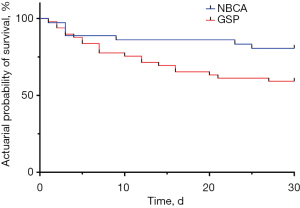 Figure 5 A Kaplan-Meier curve illustrating the actuarial probability of survival within 30 days following TAE. GSP, gelatin sponge particle; NBCA, N-butyl cyanoacrylate; TAE, transcatheter arterial embolization.
 - Bleeding-related mortality: the 30-day bleeding-related mortality was 8.3% (3/36) in the NBCA group and 14.3% (7/49) in the GSP group (P>0.05). At 6 months, bleeding-related mortality was 16.7% (6/36) in the NBCA group and 30.7% (15/49) in the GSP group (P>0.05).

Complication spectrum
According to the Clavien-Dindo classification, no major complications (grade III–V) occurred in either group (0/85). Minor complications (grade I–II) occurred in 34.1% (29/85) of patients, with no significant difference between the NBCA group [36.1% (13/36)] and the GSP group [32.7% (16/49); P=0.74] (Table 2). Clinical manifestations included self-limiting low-grade fever (<38.5 ℃), transient abdominal discomfort, and mild contrast reactions, all of which resolved with conservative symptomatic treatment.
Factors associated with clinical success and mortality
Clinical success
Univariate and multivariable logistic regression analyses were performed to identify factors associated with clinical success. Variables with P<0.1 in univariate analysis (including TNM stage, preoperative hemoglobin, INR, and embolic agent) were entered into the multivariable model. Multivariate analysis revealed three factor associated with clinical success following TAE: TNM stage IV [adjusted odds ratio (aOR) =0.040; 95% confidence interval (CI): 0.004–0.402; P=0.006], preoperative hemoglobin ≤60 g/L (aOR =0.068; 95% CI: 0.015–0.302; P=0.001), and the use of NBCA as an embolic agent (aOR =4.461; 95% CI: 1.017–19.565; P=0.047). No other demographic, disease-related, or treatment-related variables showed a statistically significant association with clinical success in the multivariate model (Table 3).
Table 3
| Variable | Univariate analysis | Multivariate analysis | |||
|---|---|---|---|---|---|
| OR (95% CI) | P value | aOR (95% CI) | P value | ||
| Demographics | |||||
| Age ≥70 years | 1.563 (0.504–4.846) | 0.43 | – | – | |
| Male sex | 1.200 (0.398–3.616) | 0.74 | – | – | |
| Disease characteristics | |||||
| Tumor location: gastric antrum | 1.657 (0.590–4.652) | 0.33 | – | – | |
| Stage IV (TNM) | 0.060 (0.008–0.477) | 0.008 | 0.040 (0.004–0.402) | 0.006 | |
| Preoperative HB ≤60 g/L | 0.123 (0.040–0.374) | 0.001 | 0.068 (0.015–0.302) | 0.001 | |
| Coagulopathy | 0.524 (0.154–1.786) | 0.30 | – | – | |
| Treatment-related | |||||
| Prior chemo/radiotherapy (within 30 days) | 0.971 (0.362–2.605) | 0.95 | – | – | |
| Positive angiography findings | 0.612 (0.209–1.796) | 0.37 | – | – | |
| Embolic agent: NBCA (vs. GSP) | 3.006 (0.983–9.190) | 0.054 | 4.461 (1.017–19.565) | 0.047 | |
P<0.05 was considered statistically significant. aOR, adjusted odds ratio; CI, confidence interval; GSP, gelatin sponge particle; HB, hemoglobin; NBCA, N-butyl cyanoacrylate; OR, odds ratio; TNM, tumor-node-metastasis.
Thirty-day mortality
Univariate analysis of factors associated with 30-day mortality is shown in Table 4. The following factors were associated with increased 30-day mortality: preoperative hemoglobin ≤60 g/L [odds ratio (OR) =12.513; P<0.001], coagulopathy (OR =9.900; P=0.001), rebleeding within 7 days (OR =138.000; P<0.001), and rebleeding within 30 days (OR =33.529; P<0.001). Conversely, the clinical success of TAE was a strong protective factor (OR =0.017; P<0.001). Factors such as age, sex, tumor location, prior therapy, angiography findings, and embolic agent type showed no significant association with mortality.
Table 4
| Variable | Univariate analysis | |
|---|---|---|
| OR (95% CI) | P value | |
| Demographics | ||
| Age ≥70 years | 1.351 (0.359–5.085) | 0.65 |
| Male sex | 0.921 (0.221–3.833) | 0.91 |
| Disease characteristics | ||
| Tumor location: gastric antrum | 0.466 (0.114–1.897) | 0.28 |
| Preoperative HB ≤60 g/L | 12.513 (2.918–53.651) | <0.001 |
| Coagulopathy | 9.900 (2.453–39.960) | 0.001 |
| Treatment-related | ||
| Prior chemo/radiotherapy (within 30 days) | 0.375 (0.092–1.525) | 0.17 |
| Positive angiography findings | 1.086 (0.261–4.517) | 0.91 |
| Embolic agent: NBCA (vs. GSP) | 0.750 (0.202–2.785) | 0.66 |
| Post–procedure outcomes | ||
| Rebleeding within 30 days | 33.529 (4.001–280.970) | <0.001 |
| Rebleeding within 7 days | 138.000 (14.586–1,305.602) | <0.001 |
| Clinical success | 0.017 (0.002–0.150) | <0.001 |
P<0.05 was considered statistically significant. CI, confidence interval; GSP, gelatin sponge particle; HB, hemoglobin; NBCA, N-butyl cyanoacrylate; OR, odds ratio.
Subgroup analysis of patients with positive angiographic findings
To address the potential confounding effect of negative angiographic findings, a subgroup analysis was performed limited to patients with positive angiographic findings (Type 1 or 2; n=22). In this subgroup, the clinical success rate was 81.8% (9/11) in the NBCA group versus 54.5% (6/11) in the GSP group. The 30-day rebleeding rate was 27.3% (3/11) in the NBCA group versus 45.5% (5/11) in the GSP group. Although the small sample size precludes definitive statistical comparison, the observed trends were consistent with the main analysis.
Discussion
This retrospective study compared 36 patients treated with NBCA and 49 patients treated with GSP for TAE in GC-UGIB. The NBCA group was associated with higher clinical success (86.1% vs. 67.3%, P=0.047) and lower rebleeding rates at both 30 days (19.4% vs. 40.8%, P=0.03). No major complications occurred in either group, and minor complication rates were comparable (36.1% vs. 32.7%, P=0.74).
The observed higher clinical success and lower rebleeding rates associated with NBCA may be attributable to the vascular characteristics of gastric cancer and the distinct embolization mechanism of NBCA. Gastric cancer bleeding is different from other common types. It mainly comes from the tumor wearing away blood vessels. This causes abnormal new blood vessels, pseudoaneurysms, poor blood vessel squeezing, and reduced natural clotting (7,18-21). Studies show about 70% of these bleeds start from the left gastric artery. Most other cases come from the gastroduodenal artery (about 20%) or the right gastroepiploic artery (about 15%) (5,19,22). Advanced-stage malignancies frequently demonstrate complex perfusion networks involving atypical feeding vessels including splenic arterial branches, short gastric conduits, diaphragmatic inferior arterial pathways, and supplementary collateral circulation (20,22-24), necessitating extensive, precise, and durable multi-vessel embolization (25-27). NBCA is a liquid embolic agent that polymerizes rapidly upon contact with ionic solutions. Its polymerization rate can be modified by premixing with varying concentrations of Lipiodol, allowing adaptation to different hemodynamic conditions. The liquid property enables distal delivery with blood flow, potentially reaching and occluding small or tortuous vessels that are less accessible to other agents. This may facilitate immediate hemostasis, which is particularly valuable in actively bleeding patients with hemodynamic instability. Furthermore, because NBCA polymerizes independently of the coagulation cascade, it may provide effective hemostasis even in patients with coagulopathy (9,11,15,16,28-31). In comparison, GSP are temporary embolic agents whose primary mechanism depends on the host’s intrinsic coagulation system. They achieve vascular occlusion by promoting platelet aggregation and facilitating fibrin deposition. These particles generally embolize more proximal arterioles and, in situations of high blood flow, may be displaced (32). This temporary occlusion may be less durable in the setting of hypervascular tumors with extensive collateral supply, potentially explaining the higher rebleeding rates observed with GSP in this cohort (33). After particle degradation, recanalization may occur, particularly in environments with high vascular endothelial growth factor (VEGF) expression, which could contribute to late rebleeding in patients with advanced disease (27,34,35). In this study, rebleeding in the GSP group predominantly occurred 2–4 weeks after the procedure, aligning closely with the reported absorption window of gelatin sponge particles, further supporting this observation (4,5,11,30). The clinical success and rebleeding rates in the NBCA group were comparable to those reported by Matsumoto et al., Hur et al., Chevallier et al. in retrospective studies and review analyses of GC-UGIB and other non-variceal gastrointestinal hemorrhages (11,16,29).
Regarding safety, no major complications were observed with NBCA in this series. Although previous studies have reported potential risks such as reflux and non-target embolization with NBCA (36,37), our findings are consistent with those of Loffroy et al., Huang et al., and Hur et al., who reported low rates of non-target embolization (1.9–5.4%) without major complications (12,17,29). The rich collateral network of the gastric vasculature may provide a wider safety margin for embolization compared to the intestinal circulation, which is more prone to ischemia (29,38-41).These safety outcomes may be attributed to meticulous technique, including superselective catheterization, adjustment of NBCA-Lipiodol ratio based on flow conditions, and careful injection monitoring to prevent reflux (17,29,30,42).
Research on TAE indicates that angiographic findings may correlate with clinical outcomes. In NVUGIB, empirical and targeted embolization show comparable effectiveness in preventing rebleeding (43). However, this pattern does not fully extend to cancer-related non-variceal gastrointestinal bleeding (CR-NVUGIB), where reported outcomes vary (22,44). For instance, Park et al. observed a significantly higher clinical success rate in patients with negative angiographic findings compared to those with positive findings (72% and 83% vs. 33%, respectively; P=0.044) (22). In contrast, Meehan et al. reported lower success in patients with negative angiographic results (33%) than in those with positive findings (44). In this analysis, angiographic findings were positive in 30.6% of patients treated with NBCA and 22.4% of those treated with GSP, a difference that was not statistically significant. Clinically, successful outcomes were observed more frequently among patients with negative angiographic findings (77.8%) compared to those with positive findings (68.2%). It is worth noting, however, that univariate analysis found no significant relationship between angiographic findings and clinical success (OR =0.612; 95% CI: 0.209–1.796; P=0.37). To further explore this, we performed a subgroup analysis limited to patients with positive angiographic findings (Type 1 or 2; n=22). Although statistical power was limited, the trends were consistent with the main analysis, with NBCA showing higher clinical success (81.8% vs. 54.5%) and lower 30-day rebleeding (27.3% vs. 45.5%) compared to GSP. These findings suggest that the advantage of NBCA may persist even when active bleeding is angiographically confirmed.
Multivariable analysis identified TNM stage IV, preoperative hemoglobin ≤60 g/L, and use of NBCA as factors independently associated with clinical success. Patients with stage IV disease and severe anemia had lower odds of success, likely reflecting more advanced tumor burden and compromised physiological reserve (4,6,12,33,45-47). The association of NBCA with higher clinical success remained significant after adjusting for these factors, suggesting an independent benefit. Notably, 30-day mortality did not differ significantly between the NBCA and GSP groups, suggesting that the initial life-saving effect of TAE is achieved with both agents. However, the lower rebleeding rates associated with NBCA may translate into longer-term benefits, particularly in patients with advanced disease who require sustained bleeding control to continue anticancer therapy. Thus, the choice of embolic agent may influence not only immediate hemostasis but also the durability of bleeding control, which is critical in this patient population.
There are several limitations in this study. First, its retrospective, non-randomized design introduces potential selection bias and confounding by indication. Although we adjusted for measured confounders such as INR in multivariable analysis, unmeasured factors (e.g., detailed tumor characteristics, operator preference, specific reasons for agent selection) may have influenced outcomes. Second, the choice of embolic agent was at the discretion of the interventional radiologist, reflecting real-world practice but also raising the possibility of selection bias. Third, the study period spanned 6 years [2018–2024]; however, no major changes in technique, equipment, or personnel occurred during this time, minimizing potential learning-curve effects. Fourth, the single-center nature limits the generalizability of our findings. Fifth, the relatively small sample size, particularly in subgroup analyses, precludes definitive statistical conclusions. Sixth, the 6-month follow-up may not capture very late rebleeding or long-term complications, and rebleeding beyond 30 days may be confounded by tumor progression. Seventh, we did not systematically assess tumor subtypes or bleeding patterns, which could affect outcomes. Future prospective, multicenter randomized controlled trials are needed to confirm these findings and to evaluate the impact of tumor characteristics, anatomic bleeding site, and treatment modality on clinical efficacy.
Conclusions
In this retrospective study of TAE for GC-UGIB, NBCA was associated with higher clinical success and lower rebleeding rates compared to GSP, without an increase in major complications. These findings suggest that NBCA may be a favorable embolic option in this setting. However, given the study’s observational design and limitations, prospective randomized trials are warranted to confirm these results and establish definitive recommendations.
Acknowledgments
None.
Footnote
Reporting Checklist: The authors have completed the STROBE reporting checklist. Available at https://jgo.amegroups.com/article/view/10.21037/jgo-2025-1-1083/rc
Data Sharing Statement: Available at https://jgo.amegroups.com/article/view/10.21037/jgo-2025-1-1083/dss
Peer Review File: Available at https://jgo.amegroups.com/article/view/10.21037/jgo-2025-1-1083/prf
Funding: This study was supported by
Conflicts of Interest: All authors have completed the ICMJE uniform disclosure form (available at https://jgo.amegroups.com/article/view/10.21037/jgo-2025-1-1083/coif). The authors have no conflicts of interest to declare.
Ethical Statement: The authors are accountable for all aspects of the work in ensuring that questions related to the accuracy or integrity of any part of the work are appropriately investigated and resolved. The study was conducted in accordance with the Declaration of Helsinki and its subsequent amendments. The study was approved by the Ethics Committee of the Affiliated Hospital of Qingdao University (No. QYFYWZLL30236). Written informed consent was obtained from all participants or their legal authorized representatives before the procedure.
Open Access Statement: This is an Open Access article distributed in accordance with the Creative Commons Attribution-NonCommercial-NoDerivs 4.0 International License (CC BY-NC-ND 4.0), which permits the non-commercial replication and distribution of the article with the strict proviso that no changes or edits are made and the original work is properly cited (including links to both the formal publication through the relevant DOI and the license). See: https://creativecommons.org/licenses/by-nc-nd/4.0/.
References
- Yang WJ, Zhao HP, Yu Y, et al. Updates on global epidemiology, risk and prognostic factors of gastric cancer. World J Gastroenterol 2023;29:2452-68. [Crossref] [PubMed]
- Bray F, Laversanne M, Sung H, et al. Global cancer statistics 2022: GLOBOCAN estimates of incidence and mortality worldwide for 36 cancers in 185 countries. CA Cancer J Clin 2024;74:229-63. [Crossref] [PubMed]
- Tang Y, Wang D, Xu Z, et al. Trends and incidence of stomach cancer in middle-aged and elderly populations: a global burden of disease analysis. J Gastrointest Oncol 2025;16:1890-901. [Crossref] [PubMed]
- Hall T, Temperley HC, Mac Curtain BM, et al. Transcatheter arterial embolisation (TAE) to treat acute upper gastrointestinal bleeding secondary to gastric cancer: A systematic review and meta-analysis. Surgeon 2024;22:e213-20. [Crossref] [PubMed]
- Gong T, Tsauo J, Ding M, et al. Transcatheter arterial embolization for cancer-related non-variceal upper gastrointestinal bleeding: A multicenter retrospective study of 107 patients. Diagn Interv Imaging 2023;104:60-6. [Crossref] [PubMed]
- Kiattiweerasak A, Bongkotvirawan P, Aumpan N, et al. Predictive factors and prognosis of upper gastrointestinal bleeding in gastric cancer: A large population-based study (UGIB-GC trial). PLoS One 2023;18:e0291926. [Crossref] [PubMed]
- Koh KH, Kim K, Kwon DH, et al. The successful endoscopic hemostasis factors in bleeding from advanced gastric cancer. Gastric Cancer 2013;16:397-403. [Crossref] [PubMed]
- Dong Q, Huang M, Lai X. Metastasis patterns and prognosis in patients with gastric cancer: a Surveillance, Epidemiology, and End Results-based analysis. J Gastrointest Oncol 2024;15:2079-87. [Crossref] [PubMed]
- Loffroy R, Falvo N, Nakai M, et al. When all else fails - Radiological management of severe gastrointestinal bleeding. Best Pract Res Clin Gastroenterol 2019;42-43:101612. [Crossref] [PubMed]
- Zhou CJ, Sun H, Tang XH. Endoscopic hemostasis combined with vascular interventional therapy for acute nonvariceal upper gastrointestinal bleeding: A meta-analysis. World J Gastrointest Surg 2025;17:111268. [Crossref] [PubMed]
- Matsumoto T, Yoshimatsu R, Shibata J, et al. Transcatheter arterial embolization of nonvariceal gastrointestinal bleeding with n-butyl cyanoacrylate or coils: a systematic review and meta-analysis. Sci Rep 2024;14:27377. [Crossref] [PubMed]
- Loffroy R, Desmyttere AS, Mouillot T, et al. Ten-year experience with arterial embolization for peptic ulcer bleeding: N-butyl cyanoacrylate glue versus other embolic agents. Eur Radiol 2021;31:3015-26. [Crossref] [PubMed]
- Širvinskas A, Smolskas E, Mikelis K, et al. Transcatheter arterial embolization for upper gastrointestinal tract bleeding. Wideochir Inne Tech Maloinwazyjne 2017;12:385-93. [Crossref] [PubMed]
- Shim JJ, Chu HH, Shin JH, et al. Clinical Outcome of the Visible Coil During Endoscopy After Transcatheter Arterial Embolization for Gastrointestinal Bleeding. Cardiovasc Intervent Radiol 2019;42:1537-44. [Crossref] [PubMed]
- Kodani M, Yata S, Ohuchi Y, et al. Safety and Risk of Superselective Transcatheter Arterial Embolization for Acute Lower Gastrointestinal Hemorrhage with N-Butyl Cyanoacrylate: Angiographic and Colonoscopic Evaluation. J Vasc Interv Radiol 2016;27:824-30. [Crossref] [PubMed]
- Chevallier O, Comby PO, Guillen K, et al. Efficacy, safety and outcomes of transcatheter arterial embolization with N-butyl cyanoacrylate glue for non-variceal gastrointestinal bleeding: A systematic review and meta-analysis. Diagn Interv Imaging 2021;102:479-87. [Crossref] [PubMed]
- Huang YS, Chang CC, Liou JM, et al. Transcatheter arterial embolization with N-butyl cyanoacrylate for nonvariceal upper gastrointestinal bleeding in hemodynamically unstable patients: results and predictors of clinical outcomes. J Vasc Interv Radiol 2014;25:1850-7. [Crossref] [PubMed]
- Kawabata H, Hitomi M, Motoi S. Management of Bleeding from Unresectable Gastric Cancer. Biomedicines 2019;7:54. [Crossref] [PubMed]
- Lee HH, Park JM, Chun HJ, et al. Transcatheter arterial embolization for endoscopically unmanageable non-variceal upper gastrointestinal bleeding. Scand J Gastroenterol 2015;50:809-15. [Crossref] [PubMed]
- Romera Barba E, Castañer Ramón-Llín J, Sánchez Pérez A, et al. Transcatheter arterial embolization in the management of acute bleeding from advanced gastric cancer. Cir Esp 2014;92:492-4. [Crossref] [PubMed]
- Ozyer U. Transcatheter Arterial Embolization with N-Butyl-2-Cyanoacrylate in the Management of Spontaneous Hematomas. Cardiovasc Intervent Radiol 2017;40:41-9. [Crossref] [PubMed]
- Park S, Shin JH, Gwon DI, et al. Transcatheter Arterial Embolization for Gastrointestinal Bleeding Associated with Gastric Carcinoma: Prognostic Factors Predicting Successful Hemostasis and Survival. J Vasc Interv Radiol 2017;28:1012-21. [Crossref] [PubMed]
- Koo HJ, Shin JH, Shin S, et al. Efficacy and Clinical Outcomes of Transcatheter Arterial Embolization for Gastrointestinal Bleeding from Gastrointestinal Stromal Tumor. J Vasc Interv Radiol 2015;26:1297-304.e1. [Crossref] [PubMed]
- Patel SR, Lowe S. Accessory Splenic Artery: A Rare Cause of Upper Gastrointestinal Bleeding. Cardiovasc Intervent Radiol 2017;40:1115-7. [Crossref] [PubMed]
- Huo X, Yuan K, Shen Y, et al. Clinical value of magnetic resonance imaging in preoperative T staging of gastric cancer and postoperative pathological diagnosis. Oncol Lett 2014;8:275-80. [Crossref] [PubMed]
- Zheng L, Shin JH, Han K, et al. Transcatheter Arterial Embolization for Gastrointestinal Bleeding Secondary to Gastrointestinal Lymphoma. Cardiovasc Intervent Radiol 2016;39:1564-72. [Crossref] [PubMed]
- Korda DÁ, Dat NT, Bibok A, et al. Determinants of clinical outcome after transarterial embolization for nonvariceal gastrointestinal bleeding: a retrospective cohort study. BMC Surg 2026;26:130. [Crossref] [PubMed]
- Kwon JH, Han YH. Efficacy and safety of superselective trans-catheter arterial embolization of upper and lower gastrointestinal bleeding using N-butyl-2-cyanoacrylate. Emerg Radiol 2018;25:111-20. [Crossref] [PubMed]
- Hur S, Jae HJ, Lee H, et al. Superselective Embolization for Arterial Upper Gastrointestinal Bleeding Using N-Butyl Cyanoacrylate: A Single-Center Experience in 152 Patients. J Vasc Interv Radiol 2017;28:1673-80. [Crossref] [PubMed]
- Kim PH, Tsauo J, Shin JH, et al. Transcatheter Arterial Embolization of Gastrointestinal Bleeding with N-Butyl Cyanoacrylate: A Systematic Review and Meta-Analysis of Safety and Efficacy. J Vasc Interv Radiol 2017;28:522-531.e5. [Crossref] [PubMed]
- Minici R, Fontana F, Venturini M, et al. A Multicenter Retrospective Cohort Study Evaluating the Clinical Outcomes of Patients with Coagulopathy Undergoing Transcatheter Arterial Embolization (TAE) for Acute Non-Neurovascular Bleeding. Medicina (Kaunas) 2023;59:1333. [Crossref] [PubMed]
- Tsurukiri J, Ohta S, Hoshiai A, et al. High-grade traumatic torso visceral injury with hemodynamic instability: effectiveness of transarterial embolization using n-butyl cyanoacrylate. Acute Med Surg 2017;4:145-51. [Crossref] [PubMed]
- Sheibani S, Kim JJ, Chen B, et al. Natural history of acute upper GI bleeding due to tumours: short-term success and long-term recurrence with or without endoscopic therapy. Aliment Pharmacol Ther 2013;38:144-50. [Crossref] [PubMed]
- Tarasconi A, Baiocchi GL, Pattonieri V, et al. Transcatheter arterial embolization versus surgery for refractory non-variceal upper gastrointestinal bleeding: a meta-analysis. World J Emerg Surg 2019;14:3. [Crossref] [PubMed]
- Yata S, Ihaya T, Kaminou T, et al. Transcatheter arterial embolization of acute arterial bleeding in the upper and lower gastrointestinal tract with N-butyl-2-cyanoacrylate. J Vasc Interv Radiol 2013;24:422-31. [Crossref] [PubMed]
- Yonemitsu T, Kawai N, Sato M, et al. Evaluation of transcatheter arterial embolization with gelatin sponge particles, microcoils, and n-butyl cyanoacrylate for acute arterial bleeding in a coagulopathic condition. J Vasc Interv Radiol 2009;20:1176-87. [Crossref] [PubMed]
- Igarashi S, Izuchi S, Ogawa Y, et al. N-butyl cyanoacrylate is very effective for massive haemorrhage during the perinatal period. PLoS One 2013;8:e77494. [Crossref] [PubMed]
- Cho SB, Hur S, Kim HC, et al. Transcatheter arterial embolization for advanced gastric cancer bleeding: A single-center experience with 58 patients. Medicine (Baltimore) 2020;99:e19630. [Crossref] [PubMed]
- Loffroy R, Favelier S, Pottecher P, et al. Transcatheter arterial embolization for acute nonvariceal upper gastrointestinal bleeding: Indications, techniques and outcomes. Diagn Interv Imaging 2015;96:731-44. [Crossref] [PubMed]
- Abul-Khoudoud N, Ludwig J, Patel R, et al. Gastroduodenal Artery Pseudoaneurysm Causing Upper Gastrointestinal Bleeding. Cureus 2025;17:e87799. [Crossref] [PubMed]
- Alali M, Cao C, Shin JH, et al. Preliminary report on embolization with quick-soluble gelatin sponge particles for angiographically negative acute gastrointestinal bleeding. Sci Rep 2024;14:6438. [Crossref] [PubMed]
- Hill H, Chick JFB, Hage A, et al. N-butyl cyanoacrylate embolotherapy: techniques, complications, and management. Diagn Interv Radiol 2018;24:98-103. [Crossref] [PubMed]
- Yu Q, Funaki B, Navuluri R, et al. Empiric Transcatheter Embolization for Acute Arterial Upper Gastrointestinal Bleeding: A Meta-Analysis. AJR Am J Roentgenol 2021;216:880-93. [Crossref] [PubMed]
- Meehan T, Stecker MS, Kalva SP, et al. Outcomes of transcatheter arterial embolization for acute hemorrhage originating from gastric adenocarcinoma. J Vasc Interv Radiol 2014;25:847-51. [Crossref] [PubMed]
- Lee HJ, Shin JH, Yoon HK, et al. Transcatheter arterial embolization in gastric cancer patients with acute bleeding. Eur Radiol 2009;19:960-5. [Crossref] [PubMed]
- Barkun AN, Almadi M, Kuipers EJ, et al. Management of Nonvariceal Upper Gastrointestinal Bleeding: Guideline Recommendations From the International Consensus Group. Ann Intern Med 2019;171:805-22. [Crossref] [PubMed]
- Zhang L, Lan Y, Dou ZL. Analysis of factors associated with 1-year rebleeding in patients with acute upper gastrointestinal bleeding and a Glasgow- Blatchford Score ≥ 6 based on serological indicators. Front Med (Lausanne) 2025;12:1668613. [Crossref] [PubMed]

